- Home »
- Microtubule associated protein rich fraction: bovine brain
Microtubule associated protein rich fraction: bovine brain
Product Uses Include
- Positive control for the study of microtubule binding proteins
- Investigation of the the effect of MAPs on microtubule dynamics
- Substrate for many protein kinases
Material
A microtubule associated protein (MAP) fraction has been isolated from bovine brain by temperature induced tubulin polymerization followed by ionic exchange chromatography over a phosphocellulose matrix and salt elution (1, 2). The MAP fraction protein is supplied as a white lyophilized powder
Purity
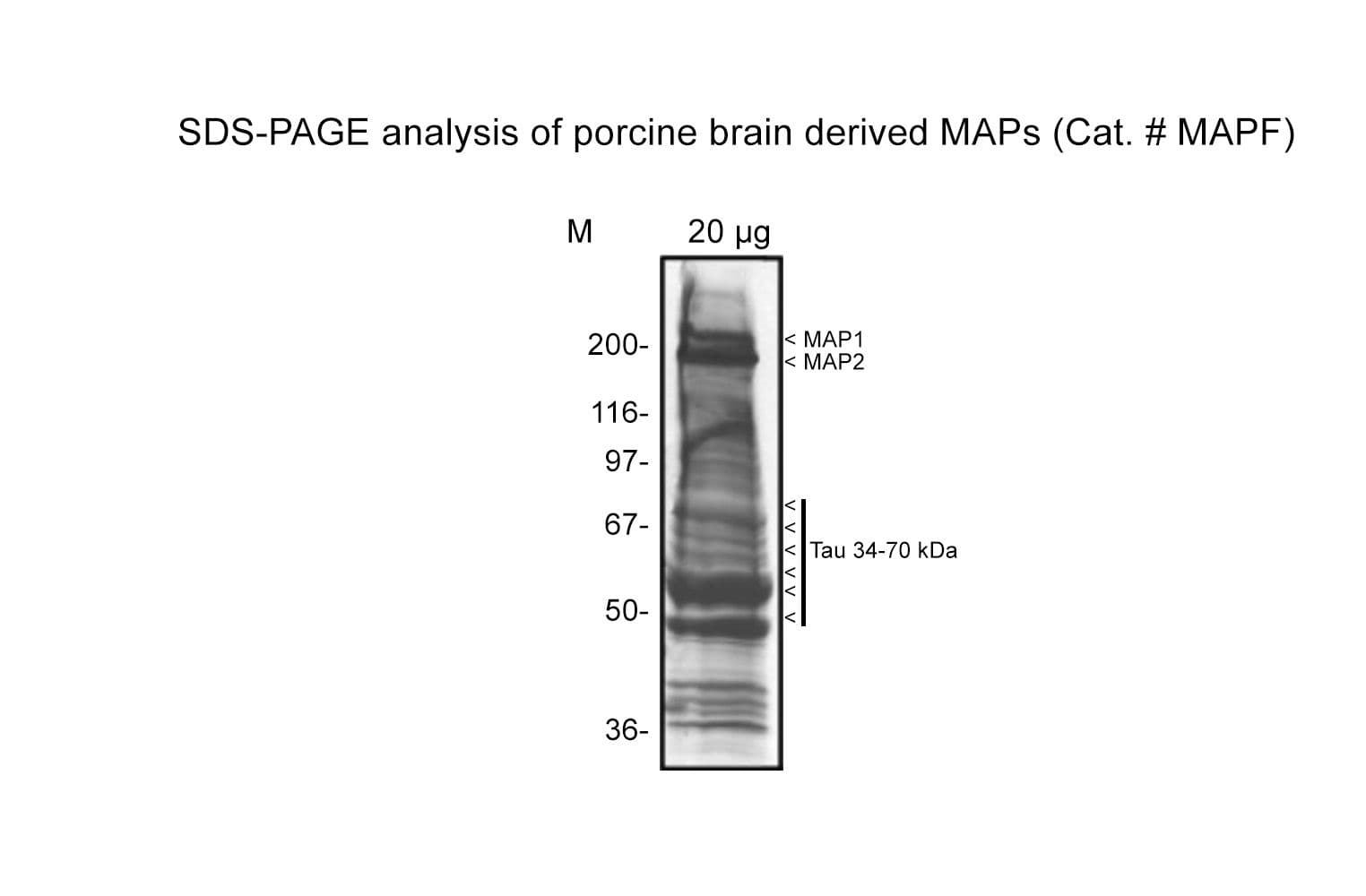
Protein purity is determined by scanning densitometry of Coomassie Blue stained protein on a 12% polyacrylamide gel. MAP2 constitutes 70% of the total protein (see Figure 1).
![]() |
||
|
|
Figure 1: Microtubule associated protein fraction purity determination. A 10 µg sample of MAPF was separated by electrophoresis in a 12% SDS-PAGE system, and stained with Coomassie Blue.
|
|
Biological Activity
The biological activity of the MAP fraction is determined by the ability of 0.1 mg/ml MAP fraction to enhance the polymerization rate (Vmax) of purified bovine brain tubulin (Cat. # TL238) in vitro. Stringent quality control ensures that the MAP fraction protein will stimulate tubulin polymerization at least five fold when compared to tubulin polymerization without MAP fraction.
![]() |
||
|
|
Figure 2: Tubulin polymerization in the presence and absence of microtubule associated protein fraction. Tubulin polymerization reactions were carried out as in BK006 with 5% glycerol containing 2 mg/ml of pure bovine brain tubulin (Cat. # TL238) being polymerized in the presence and absence of 0.1 mg/ml MAP fraction protein.
|
|
References
- Vallee, R. B. 1982. J. Cell Biol. 92, 435-442
- Kuznetsov S. A., et al. 1981. FEBS Lett. 135, 241-244
For product Datasheets and MSDSs please click on the PDF links below. For additional information, click on the FAQs tab above or contact our Technical Support department at tservice@cytoskeleton.com
Cho, H. P., Liu, Y., Gomez, M., Dunlap, J., Tyers, M. and Wang, Y. (2005). The dual-specificity phosphatase CDC14B bundles and stabilizes microtubules. Mol. Cell. Biol. 25, 4541-4551.
Satish, L., Blair, H. C., Glading, A. and Wells, A. (2005). Interferon-inducible protein 9 (CXCL11)-induced cell motility in keratinocytes requires calcium flux-dependent activation of μ-calpain. Mol. Cell. Biol. 25, 1922-1941.
Teckchandani, A. M., Birukova, A. A., Tar, K., Verin, A. D. and Tsygankov, A. Y. (2005). The multidomain protooncogenic protein c-Cbl binds to tubulin and stabilizes microtubules. Exp. Cell Res. 306, 114-127.
Mamoune, A., Luo, J. H., Lauffenburger, D. A. and Wells, A. (2003). Calpain-2 as a target for limiting prostate cancer invasion. Cancer Res. 63, 4632-4640.
Nielsen, F. C., Nielsen, J., Kristensen, M. A., Koch, G. and Christiansen, J. (2002). Cytoplasmic trafficking of IGF-II mRNA-binding protein by conserved KH domains. J. Cell Sci. 115, 2087-2097.
Coming soon! If you have any questions concerning this product, please contact our Technical Service department at tservice@cytoskeleton.com
Browse Products
You have no items in your shopping cart.
You have no items to compare.
-
1/1/12FtsZ Protein News Read more
-
12/6/11Neuroscience News Read more