Loading
 

About Acti-stain
The Acti-stain™ line of fluorescent phalloidins has been developed with an emphasis on creating exceptionally bright and stable probes at an economical price. Side-by-side comparisons with leading competing products demonstrate that you will enjoy savings while not sacrificing the quality of the stain when switching to an Acti-stain™ probe. Additionally, these probes are compatible with popular filter sets such as FITC, TRITC and Cy5. The combination of in-house manufacturing, stringent quality control and convenient packaging provides a great value. Give them a try and see for yourself.

Product Uses Include

  • Stain F-actin in fixed cells
  • Stabilize actin filaments in vitro
  • Visualize actin filaments in vitro


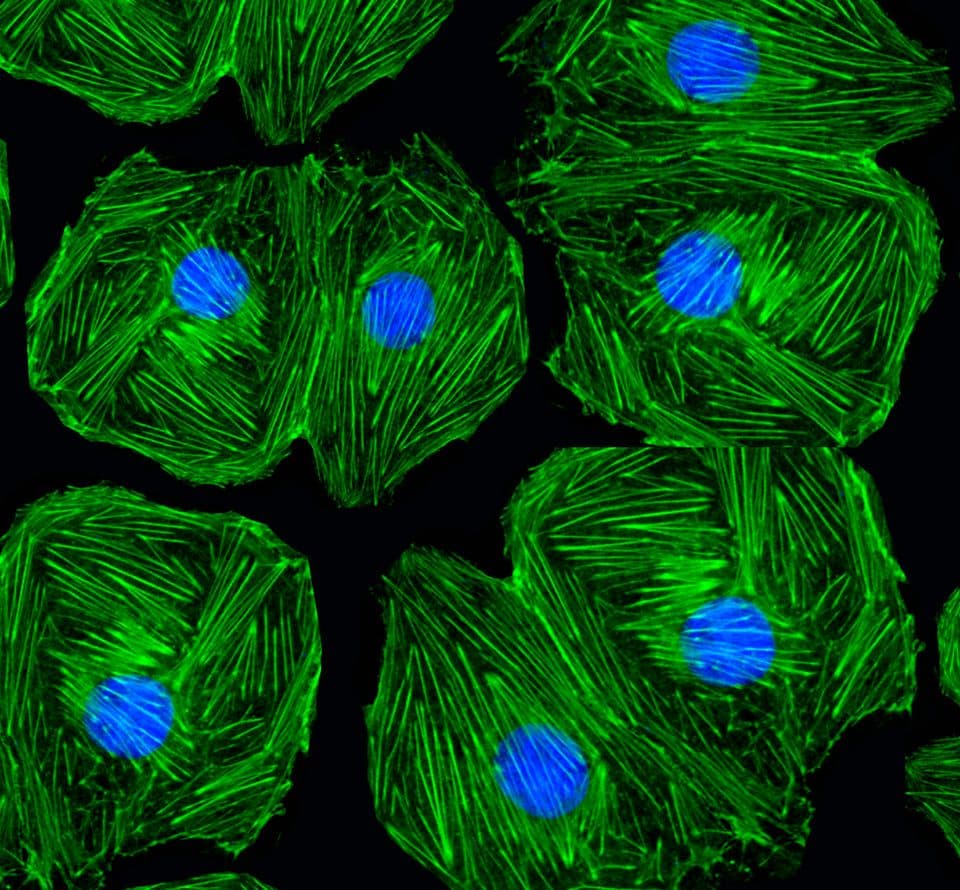
Actin staining is very useful in determining the structure and function of the cytoskeleton in living and fixed cells. The actin cytoskeleton is a very dynamic and labile structure in the living cell, but it can be fixed with paraformaldehyde prior to probing or staining for actin structures. 

Acti-stain™ 488 phalloidin
Cat. # PHDG1
Acti-stain™ 555 phalloidin
Cat. # PHDH1
Acti-stain™ 670 phalloidin
Cat. # PHDN1
Swiss 3T3 cell stained with anti-vinculin (red), Dapi (blue nucleus) and F-actin is stained with Acti-stain™ 488 (green F-actin, Cat.# PHDG1). Swiss 3T3 cell with activated Rho, nucleus is stained with Dapi (blue) and F-actin is stained with Acti-stain™ 555 (red F-actin, Cat.# PHDH1). Mitotic Swiss 3T3 cell, F-actin stained with Acti-stain™ 670 (far-red, Cat. # PHDN1), nuclear DNA stained with Dapi (blue).


Specifications:

Figure 2. Emission and excitation scans for Acti-stain™ phalloidins

2 4 6

Absorbance and fluorescence scan of Acti-stain™ 488. Labeled phalloidin was diluted into methanol and its absorbance and excitation spectra were scanned between 350-750 and 500-750 nm, respectively. Absorbance peaks at 500 nm and fluorescence at 550 nm.

Absorbance and fluorescence scan of Acti-stain™ 555. Labeled phalloidin was diluted into methanol and its absorbance and excitation spectra were scanned between 300-750 and 560-750 nm, respectively. Absorbance peaks at 560 nm and fluorescence at 575 nm.

Absorbance and fluorescence scan of Acti-stain™ 670. Labeled phalloidin was diluted into methanol and its absorbance and excitation spectra were scanned between 300-750 and 600-750 nm, respectively. Absorbance peaks at 625 nm and fluorescence at 675 nm.


Acti-stain phalloidins are the most well characterized phalloidins available. Tabe 1 describes their brightness, photostability, background and affinity constants to F-actin. Compare these performance characteristics to other fluorescent phalloidins and you will see the advantages of using Acti-stain™ for your actin staining requirements.

Table 1. Biochemical characteristics of fluorescent phalloidins

Conjugate Cat.#

Wavelengths (Ex/Em)

Brightness (AFU*)

Stability to photobleaching(half life in seconds**)

Background (% of total AFU at 100nM**)

Affinity (Kd in nanomolar)

Fluorescein-phalloidin

na 485/535 FITC filter set 432 6 22 72 +/-12

Acti-stain™ 488

PHDG1 485/535 FITC filter set 832 57 5 55 +/-8

Acti-stain™ 535

PHDR1 535/585 TRITC filter set 430 27 12 36 +/-7

Acti-stain™ 555

PHDH1 535/585 TRITC filter set 551 46 16 63 +/-8

Acti-stain™ 670

PHDN1 640/680 Cy5 filter set 332 8 18 50 +/-12

* = AFU's measured by quantitative cell imaging. ** = Measured in stained Swiss 3T3 cells in the absence of antifade.


For more information about protocols to fix and stain cells click here.


Manuals and MSDS

Product Cat.#

Manual

MSDS

Acti-stain™ 488

PHDG1

Acti-stain™ 555

PHDH1

Acti-stain™ 670

PHDN1


Related Products