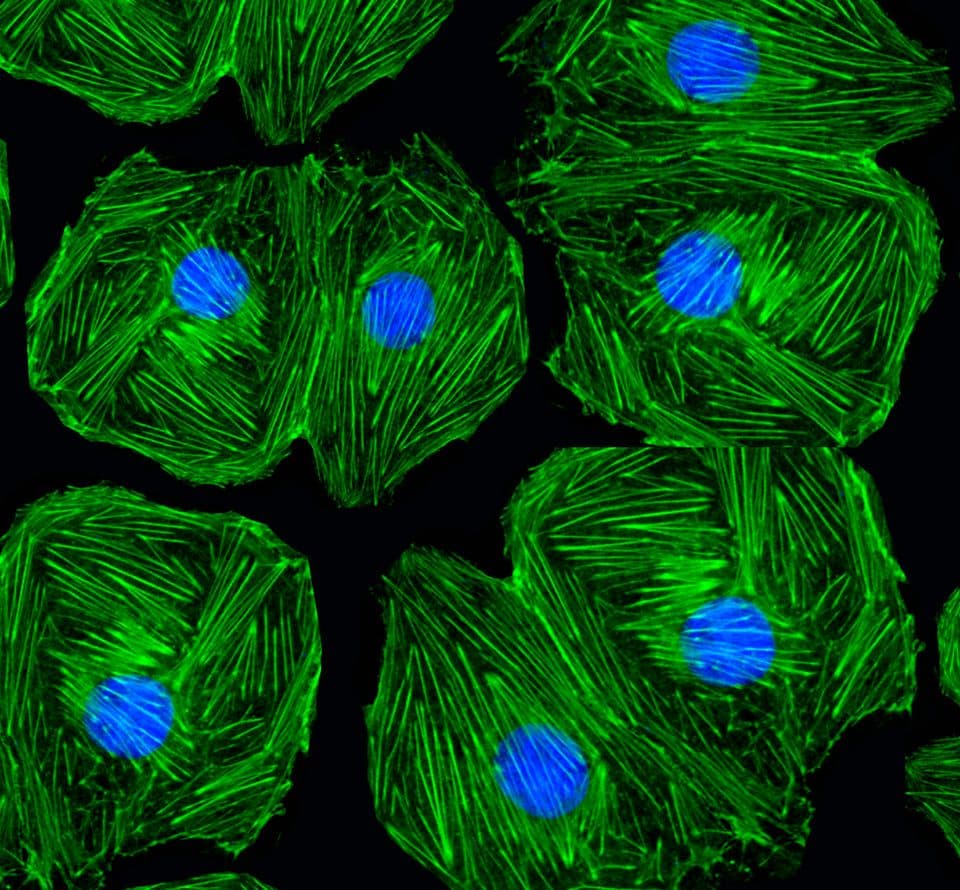
About Acti-stain™ 
The Acti-stain™ line of fluorescent phalloidins has been developed with an emphasis on creating exceptionally bright and stable probes at an economical price. Side-by-side comparisons with leading competing products demonstrate that you will enjoy savings while not sacrificing the quality of the stain when switching to an Acti-stain™ probe. Additionally, these probes are compatible with popular filter sets such as FITC, TRITC and Cy5. The combination of in-house manufacturing, stringent quality control and convenient packaging provides a great value. Give them a try and see for yourself.
Product Uses Include
- Stain F-actin in fixed cells
- Stabilize actin filaments in vitro
- Visualize actin filaments in vitro
Actin staining is very useful in determining the structure and function of the cytoskeleton in living and fixed cells. The actin cytoskeleton is a very dynamic and labile structure in the living cell, but it can be fixed with paraformaldehyde prior to probing or staining for actin structures.
Click here for Acti-stain specifications
Click here for General F-actin staining information and protocols
For product Datasheets and MSDSs please click on the PDF links below. For additional information, click on the FAQs tab above or contact our Technical Support department at tservice@cytoskeleton.com.
Cytoskeleton's Acti-stain products have been cited hundreds of times over the past two decades. A select few are described here, for more citations on individual products please use the "Citations" tab on each individual product page.
Acti-stain 535, Phalloidin (rhodamine): 14uM (Cat. # PHDR1)
|
| Ezratty, E. J., Partridge, M. A. and Gundersen, G. G. (2005). Microtubule-induced focal adhesion disassembly is mediated by dynamin and focal adhesion kinase. Nat. Cell Biol. 7, 581-590. |
| Gomes, E. R., Jani, S. and Gundersen, G. G. (2005). Nuclear movement regulated by Cdc42, MRCK, myosin, and actin flow establishes MTOC polarization in migrating cells. Cell 121, 451-463. |
Acti-stain 488, Phalloidin (Hilyte 488): 14uM (Cat. # PHDG1)
|
| Yeast publication ? Brian. |
| other?. |
Acti-stain 555, Phalloidin (Hilyte 555): 14uM (Cat. # PHDH1)
|
| Introduced in April 2011, currently there are no citations for this product. |
| ... |
Acti-stain 670, Phalloidin (Hilyte 647): 14uM (Cat. # PHDN1)
|
| Introduced in April 2011, currently there are no citations for this product.. |
| ... |
Question 1: Which is the most stable/brightest Acti-stain conjugate?
Answer 1: The brightest and most stable of the Acti-stains is Acti-stain 488 (green fluorescence; Cat. # PHDG1). Please see the table below for additional information on all of our Acti-stains.
|
Conjugate
|
Cat. #
|
Wavelengths (Ex/EM)
|
Brightness (AFU)
|
Stability to photobleaching* (1/2 life in sec)
|
Background (% of total AFU at 100 nM)
|
|
Acti-stain™ 488
|
PHDG1
|
485/535
|
832
|
57
|
5
|
|
Acti-stain™ 535
|
PHDR1
|
535/585
|
430
|
27
|
12
|
|
Acti-stain™ 555
|
PHDH1
|
535/585
|
551
|
46
|
16
|
|
Acti-stain™ 670
|
PHDN1
|
640/680
|
332
|
8
|
18
|
* = measured in the absence of antifade.
Question 2: What fixation conditions are recommended when staining with phalloidin conjugates?
Answer 2: Fluorescent phalloidins only bind to the native quaternary structure of F-actin which provides a low background. The correct fixation condition for phalloidin binding is 3.7% (v/v) paraformaldehyde in PBS for 10 min because it retains the quaternary protein structure which is necessary for high affinity binding of phalloidin. Methanol fixation destroys the native conformation and hence is not suitable for F-actin staining with phalloidin.
For more information about staining procedures and specifications of the Acti-stain series, please click here.