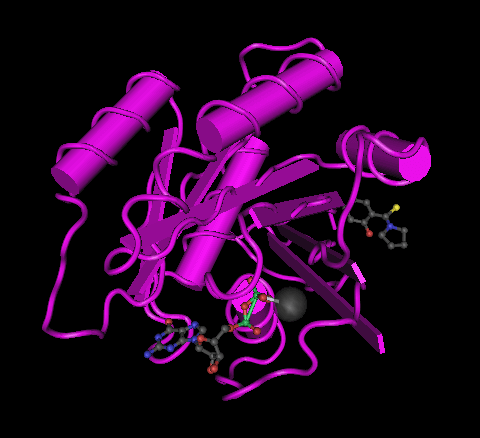
Recently, Sakamoto et al. discovered novel peptide inhibitors of the G12D mutant K-Ras GTPase. Of the three Ras isoforms (H-, K-, and N-), K-Ras is considered the most relevant anti-cancer drug target as K-Ras mutations underlie 86% of Ras-linked cancers with 83% of K-Ras mutations at the G12 residue. Development of K-Ras-targeting anti-cancer drugs remains elusive due to the paucity of small, druggable pockets on the GTPase’s surface and picomolar binding affinity between K-Ras and GDP/GTP nucleotides. Here, the authors screened random peptide libraries displayed on T7 phage against recombinant G12D K-Ras in the presence of GDP to identify selective G12D K-Ras inhibitors. Sequence optimization produced a selective G12D K-Ras inhibitor (IC50, 1.6 nM) in a SOS1-mediated GDP/GTP exchange assay. At 30 mM, this inhibitor also reduced proliferation and downstream K-Ras signaling in cancer cells. While less than optimal cell membrane permeability and loss of activity under reducing conditions were shortcomings with this peptide, the discovery of selective G12D K-Ras inhibitors provides a blueprint for the design of future, clinically-relevant K-Ras inhibitors. Cytoskeleton’s SOS1 exchange domain protein (564-1049 amino acids; Cat.# CS-SOS1) was used in the GDP/GTP exchange assay to confirm inhibition of G12D K-Ras activation using BODIPY-FL-GDP.
Link to citation:
Products used in this citation:
Human SOS1 Protein (Exchange Domain 564-1049) (Cat. # CS-SOS1)