1. Home
  2. SiR-DNA nuclear stain

Nuclear DNA staining (fluorescent probe) for FACs, high content screening, live cell studies and chromosome tracking

There are several classes of DNA fluorescence probes such as ethidium bromide, Dapi, Hoechst™ and far-red dyes such as SiR-DNA™, Syto61™, DRAQ5™ or Vybrant® DyeCycle™ Ruby. Currently among the DNA stains that work on live cells, there are two groups. The first is the Hoechst series which are cell permeable and fluorogenic (i.e. low fluorescence until binding target DNA), but they are quite toxic due to the requirement for short UV-blue wavelength excitation in the 340-360 nm range.

The second group of live cell dyes consists of far-red dyes such as SiR-DNA™, Syto61™, DRAQ5™ or Vybrant® DyeCycle™ Ruby. These dyes overcome the limitations arising from the spectral range of the previous group and permit the use of low energy excitation light with a wavelength of around 650 nm and emit around 700 nm. This light is minimally phototoxic (as for SiR-tubulin™ and SiR-actin™) and cells or tissue samples do not absorb light or emit autofluorescence in this range of the spectrum. This makes it possible to image deeper sections in thick samples.

In contrast, Dapi and Ethidium bromide are not cell permeable and one of short these also requires short UV wavelength excitation (Dapi) and the other is wavelength blue light in the range of 350 nm is very energetic and can cause photo-damage (oxidation) to live cells if they are imaged for more than 1-10 min. In addition, in this spectral range, tissues and cells have a high absorbance and autofluorescence. It is therefore very difficult to image deep within tissue samples. Finally, these dyes are not very well suited for superresolution due to the limitation of time of cell exposure to excitation light. mutagenic (Ethidium bromide).

SiR-DNA™ (Spirochrome SA) has further advantages over the far-red group of dyes. The problem with Syto61™, DRAQ5™ or Vybrant® DyeCycle™ Ruby dyes is that they either display a strong toxic effect on the cells at the concentrations the supplier recommends to use them (the cells stop to divide or die), whereas SiR-DNA can be used continuously over normal experimental time courses of 8 h, and probably much longer. The Syto61™, DRAQ5™

or Vybrant® DyeCycle™ Ruby dyes also create a strong non-specific signal on other structures than DNA in living cells. Syto 61 is compatible with superresolution microscopy but its high background fluorescence and its toxicity make it not an attractive choice. SiR-DNA signals remain strong with many exposures to excitation light, in tests of stability the dye retained 70% of its original intensity after 140 exposures / time point recordings.

The main advance of developing SiR-DNA™ is to combine the fluorogenic character, high DNA specificity and the low toxicity with the far-red excitation/emission range. In addition the probe performs extremely well with superresolution microscopy (STED and SIM) due to its stability and requirement for far-red light. Therefore, SiR-DNA is a superior probe with unmatched properties just as SiR-tubulin and SiR-actin.

In microscopy and high content screening, SiR-DNA™ allows facile nuclear counterstaining without UV excitation. In flow cytometry, SiR-DNA™ allows phenotyping of blood/

Cytoskeleton Image
Cytoskeleton Image
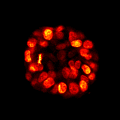
Live MCF-7 breast cancer cell spheroid stained with SiR-DNA
Cytoskeleton Image
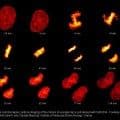
Live cell time lapse confocal imaging of a HeLa cell stained with SiR-DNA, note the very low background.

To order SiR-DNA Spriochrome product via Cytoskeleton Inc, click here.

For more information on the SiR-DNA product from Spirochrome click this link.

SiR-DNA™ is a trademark of Spirochrome SA (Switzerland).

Vybrant® DyeCycle™ Ruby stain is a trademark of Thermo Fisher Scientific USA (Molecular Probes Inc.).

DRAQ5™ is a trademark of Biostatus Ltd.

Syto61™ is a trademark of Thermo Fisher Scientific USA (Molecular Probes Inc.).

Hoechst™ is a trademark of Sanofi USA.

Cytoskeleton, Inc
Contact UsMy Account

Tel: 303-322-2254

  • Blogs
  • FAQ's
  • Datasheets and MSDS
  • Protocols
  • Learning Documents
  • Videos
  • About Us
  • Careers
  • Distributors
  • All Services
  • Compound Screening
  • Protein Purification
  • Assay Development
  • Post-Translational Modification (PTM) Tools
  • Motor Protein Products
  • Live Cell Imaging Reagents
  • Actin Products
  • ECM Proteins
  • Small G-protein Products
  • Tubulin & FtsZ Products
  • General Protein Tools
Linkedin

© 2026 Cytoskeleton, Inc All Rights Reserved.

Privacy Policy

TEL: 303-322-2254

Log in to your Account
Cytoskeleton, IncCytoskeleton, Inc
Your quote is empty.
Your cart is empty.
  • Cytoskeleton, Inc
  • Products
    • Featured New Product
    • Small G-protein Products
      • Small G-protein Activators & Inhibitors
      • Small G-protein Activation Assays
      • Small GTPase Affinity Beads
      • Small G-protein GEF/GAP and ELISA Kits
      • Small G-proteins
      • Modulator Proteins
      • Small G-protein Antibodies
      • Small G-protein Buffers
    • Post-Translational Modification (PTM) Products
      • Ubiquitination Tools
      • Acetyl-Lysine Tools
      • SUMOylation Tools
      • Phosphotyrosine Tools
      • Actin Oxidation Tools
      • Antibodies: PTMtrue™
      • Cell Lysis Tools
    • Tubulin & FtsZ Products
      • Tubulin Kits
      • Microtubules & Tubulin Proteins
      • Fluorescent and Labeled Tubulins
      • Microtubule-Associated Proteins (MAPs)
      • Live Cell Tubulin Reagents
      • Tubulin Antibodies
      • FtsZ Proteins
      • Tubulin Drugs and Buffers
    • Actin Products
      • Acti-stain™ Fluorescent Phalloidins
      • Actin Assays & Kits
      • Actin Proteins
      • Fluorescent and Labeled Actin
      • Actin Binding Proteins
      • Live Cell Actin Reagents
      • Actin Oxidation Tools
      • Actin Antibodies
      • Actin Drugs & Buffers
    • Live Cell Imaging Reagents
      • Live Cell Actin Reagents
      • Live Cell Tubulin Reagents
      • Small G-protein Activators & Inhibitors
      • Nuclear DNA Probes
      • Live Cell Membrane Probes
        • Plasma Membrane Probes
        • Membrane Tension Probes
        • Membrane Polarity Probes
      • Live Cell Mitochondrial Reagents
      • ECM Proteins
        • Fluorescent Fibronectin
        • Fluorescent Laminin
      • Live Cell Lipid Droplets
      • Other Organelles
      • Dyes/Substrates
    • ECM Proteins
      • Fluorescent Fibronectin
      • Fluorescent Laminin
    • Motor Protein Products
      • Motor Kits and Assays
      • Kinesin Proteins
      • Myosin Proteins
      • Dynein Proteins
      • Motor Protein Drugs & Buffers
    • General Protein Tools
      • Protein Quantitation
      • Cell Lysis Tools
      • ATPase & GTPase Assays
      • Other Protein Tools
    • GO-Blot V2 - Fully Automated And Programmable Western Blot Processor
  • Custom Services
    • All Services
    • Compound Screening
      • Tubulin Polymerization Assay Services
      • Kinesin ATPase Screening Services
      • Myosin ATPase Screening Services
      • GTP Exchange Factor (GEF) Assay Services
      • GTPase Activating Protein (GAP) Assay Services
      • FtsZ GTPase and Polymerization Assay Services
      • GTPase Activation Screening Services
    • Protein Purification
    • Assay Development
  • Resources
    • Resource Hub
      • Blogs
      • Videos
      • Protocols
      • Learning Documents
        • Ebook
    • FAQs
    • Datasheets and MSDS
  • About Us
    • About Us
    • Careers
    • Distributors
  • Contact Us