1. Home
  2. About HAK-actin and expansion microscopy

About HAK-actin™
HAK-actin™ is a pan-species Expansion Microscopy (ExM) compatible probe for actin visualization using U-ExM based protocols. HAK-actin™ binds specifically to F-actin. Its design allows HAK-actin™ to be anchored into the gel and expand faithfully to the original actin structure after the swelling step. HAK-actin™ contains an HA tag epitope, it can therefore be detected post expansion using a pair of anti-HA and species specific secondary antibodies. It combines simplicity through a single protocol and versatility as the fluorophore label on the secondary antibody can be chosen freely. Finally, the primary + secondary antibody boosts fluorescent signal amplification, circumventing volumetric dilution of the fluorescent signal due to expansion.

HAK-actin
Cat. # CY-SC019

Sanity Image
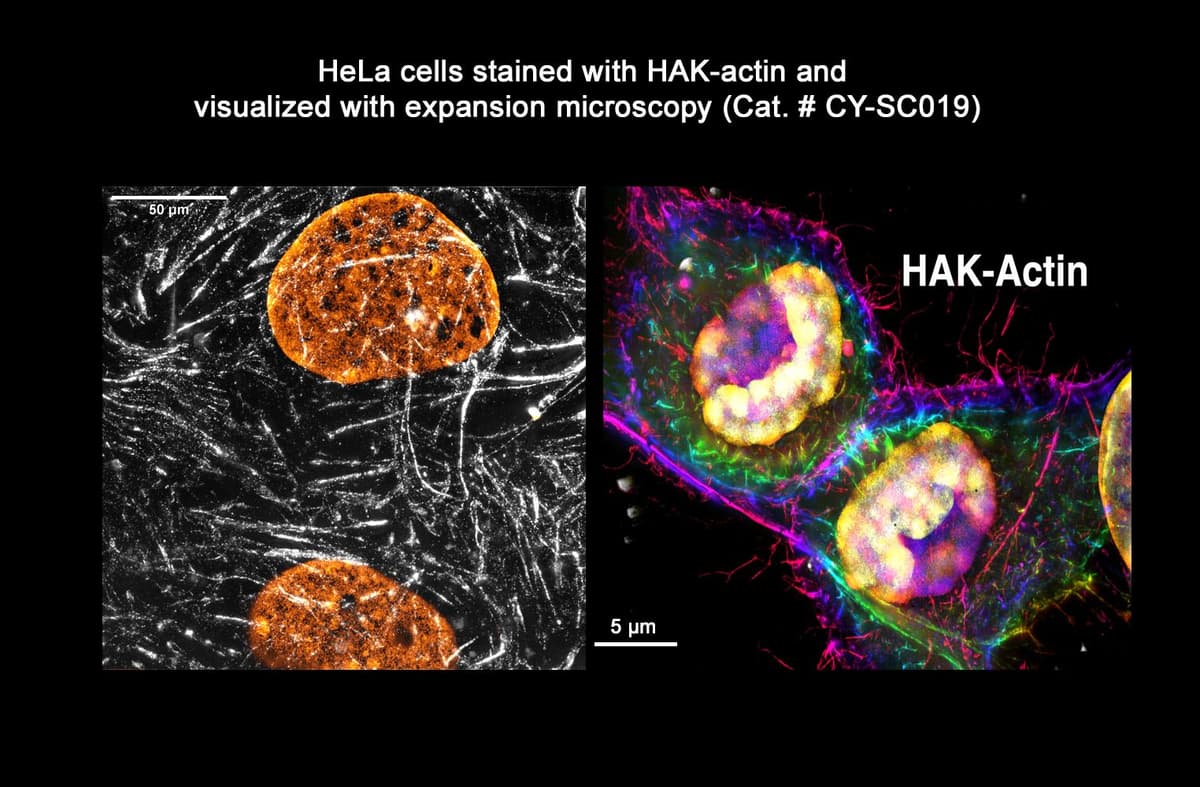
HAK-actin in tissue culture cells

HeLa cells stained with HAK-actin, on the right showing depth as a color spectrum.

Samples were fixed and processed for expansion microscopy as detailed in Mercey O. et al. 2025. After two 5 min washes in PBS, samples were expanded (using 3 rounds of H2O), and incubated with rabbit-anti HA (1/340 dilution, orange on left) in blocking buffer plus SPY650-DNA for 3.5 h at RT. After 3 washes in PBS PBS/0.2% TritonX100, they were incubated with secondary antibody (1/500 dilution) in blocking buffer for 90 min at RT in the dark.
Gels were then washed in PBS and PBS/0.2% TritonX100 and mounted in anti-fade media.

Mercey O. et al 2025. HAK-actin, U-ExM-compatible probe to image the actin cytoskeleton. https://www.biorxiv.org/content/10.1101/2025.08.26.672318v1.

How does HAK-actin™ work?

The HAK-actin™ probe contains 3 key elements:

1. A pan-species, highly specific, high affinity F-actin ligand for a robust binding to polymerized actin (F-actin) only.

2. An anchoring moiety that specifically reacts with acrylamide and covalently links HAK-actin™ to the expansion gel.

3. The HA-tag epitope sequence for a strong and specific recognition by anti-HA antibodies, even after expansion.
Sanity Image
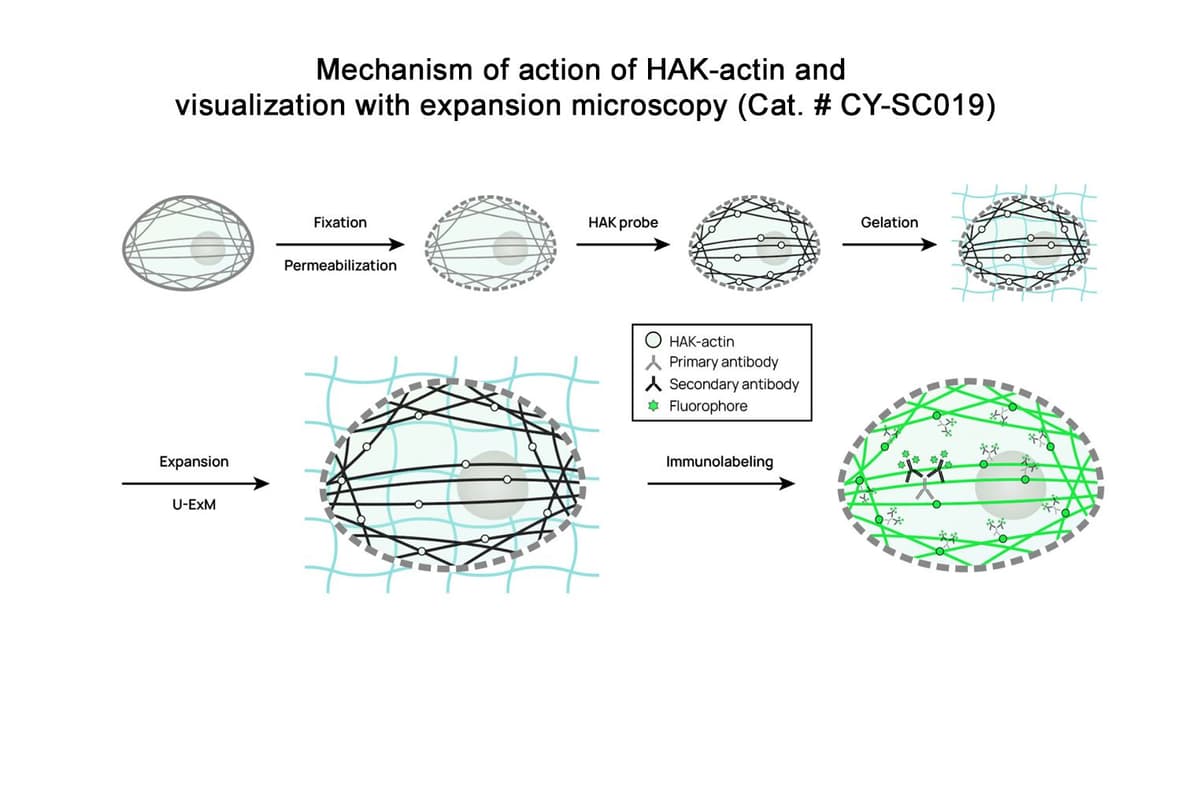
Mechanism of action of HAK-actin
Figure 1. After fixation (chemical or cryo) and permeabilization, the sample to be expanded is treated with HAK-actin™. The probe’s actin ligand uniformly labels F-actin within the cells. The sample is then subjected to U-ExM (or iU-ExM) protocol. During the protocol, HAK-actin™ is covalently bound within the expansion gel and expands faithfully with the sample. The final immunolabeling step using a primary anti-HA and a fluorescently labeled secondary antibody boosts the fluorescent signal and reveals the expanded actin structure with high contrast.
Stronger signal via post-expansion immunostaining. The HA tag allows post-U-ExM labeling with standard anti-HA antibodies, giving ~4× higher fluorescence than a directly labeled probe. The user is free to choose any fluorophore on the secondary antibody.

Robust anchoring/retention in the gel. Four lysines promote efficient crosslinking to the U-ExM polymer, yielding bright, specific actin staining with low background.

Wide protocol compatibility. Works with standard U-ExM, cryo-ExM (better ultrastructure preservation), and iterative U-ExM (up to ~16× expansion), and can be multiplexed with other labels (e.g., Microtubules or membranes with mCLING).

Broad applicability across models. Delivers uniform actin labeling in human cells (U2OS), neurons (growth cones, dendritic spines), platelets, mouse retina (clearer signal in the ciliary bulge), and diverse microbial eukaryotes—including cell-walled species where anti-actin or phalloidin often fail.

Overcomes key ExM limitations. By using post-labeling, it avoids the fluorophore dilution and color constraints of pre-labeling approaches (e.g., AcX-based phalloidin linkers), doesn’t require species-specific antibodies or genetic tagging, and simplifies a reproducible workflow.

No transfection or expression required. HAK-actin does not require genetic expression of tagged actin monomers. It labels endogenous actin.

Note: HAK-actin™ has been specifically designed for U-ExM, iU-ExM and Cryo-ExM protocols, other ExM methods might not work. The detailed protocols of these compatible expansion microscopy methods can be found in the following publications:

U-ExM: https://doi.org/10.1016/bs.mcb.2020.05.006

iU-ExM: https://doi.org/10.1038/s41467-023-43582-8

Cryo-ExM: https://doi.org/10.1038/s41592-021-01356-4

Manuals and MSDS

To view the Manual and MSDS sheets, please click on the links below:

datasheet

msds

Cytoskeleton, Inc
Contact UsMy Account

Tel: 303-322-2254

  • Blogs
  • FAQ's
  • Datasheets and MSDS
  • Protocols
  • Learning Documents
  • Videos
  • About Us
  • Careers
  • Distributors
  • All Services
  • Compound Screening
  • Protein Purification
  • Assay Development
  • Post-Translational Modification (PTM) Tools
  • Motor Protein Products
  • Live Cell Imaging Reagents
  • Actin Products
  • ECM Proteins
  • Small G-protein Products
  • Tubulin & FtsZ Products
  • General Protein Tools
Linkedin

© 2026 Cytoskeleton, Inc All Rights Reserved.

Privacy Policy

TEL: 303-322-2254

Log in to your Account
Cytoskeleton, IncCytoskeleton, Inc
Your quote is empty.
My Cart
( Items)
  • Cytoskeleton, Inc
  • Products
    • Featured New Product
    • Small G-protein Products
      • Small G-protein Activators & Inhibitors
      • Small G-protein Activation Assays
      • Small GTPase Affinity Beads
      • Small G-protein GEF/GAP and ELISA Kits
      • Small G-proteins
      • Modulator Proteins
      • Small G-protein Antibodies
      • Small G-protein Buffers
    • Post-Translational Modification (PTM) Products
      • Ubiquitination Tools
      • Acetyl-Lysine Tools
      • SUMOylation Tools
      • Phosphotyrosine Tools
      • Actin Oxidation Tools
      • Antibodies: PTMtrue™
      • Cell Lysis Tools
    • Tubulin & FtsZ Products
      • Tubulin Kits
      • Microtubules & Tubulin Proteins
      • Fluorescent and Labeled Tubulins
      • Microtubule-Associated Proteins (MAPs)
      • Live Cell Tubulin Reagents
      • Tubulin Antibodies
      • FtsZ Proteins
      • Tubulin Drugs and Buffers
    • Actin Products
      • Acti-stain™ Fluorescent Phalloidins
      • Actin Assays & Kits
      • Actin Proteins
      • Fluorescent and Labeled Actin
      • Actin Binding Proteins
      • Live Cell Actin Reagents
      • Actin Oxidation Tools
      • Actin Antibodies
      • Actin Drugs & Buffers
    • Live Cell Imaging Reagents
      • Live Cell Actin Reagents
      • Live Cell Tubulin Reagents
      • Small G-protein Activators & Inhibitors
      • Nuclear DNA Probes
      • Live Cell Membrane Probes
        • Plasma Membrane Probes
        • Membrane Tension Probes
        • Membrane Polarity Probes
      • Live Cell Mitochondrial Reagents
      • ECM Proteins
        • Fluorescent Fibronectin
        • Fluorescent Laminin
      • Live Cell Lipid Droplets
      • Other Organelles
      • Dyes/Substrates
    • ECM Proteins
      • Fluorescent Fibronectin
      • Fluorescent Laminin
    • Motor Protein Products
      • Motor Kits and Assays
      • Kinesin Proteins
      • Myosin Proteins
      • Dynein Proteins
      • Motor Protein Drugs & Buffers
    • General Protein Tools
      • Protein Quantitation
      • Cell Lysis Tools
      • ATPase & GTPase Assays
      • Other Protein Tools
    • GO-Blot V2 - Fully Automated And Programmable Western Blot Processor
  • Custom Services
    • All Services
    • Compound Screening
      • Tubulin Polymerization Assay Services
      • Kinesin ATPase Screening Services
      • Myosin ATPase Screening Services
      • GTP Exchange Factor (GEF) Assay Services
      • GTPase Activating Protein (GAP) Assay Services
      • FtsZ GTPase and Polymerization Assay Services
      • GTPase Activation Screening Services
    • Protein Purification
    • Assay Development
  • Resources
    • Resource Hub
      • Blogs
      • Videos
      • Protocols
      • Learning Documents
        • Ebook
    • FAQs
    • Datasheets and MSDS
  • About Us
    • About Us
    • Careers
    • Distributors
  • Contact Us
Your cart is empty.