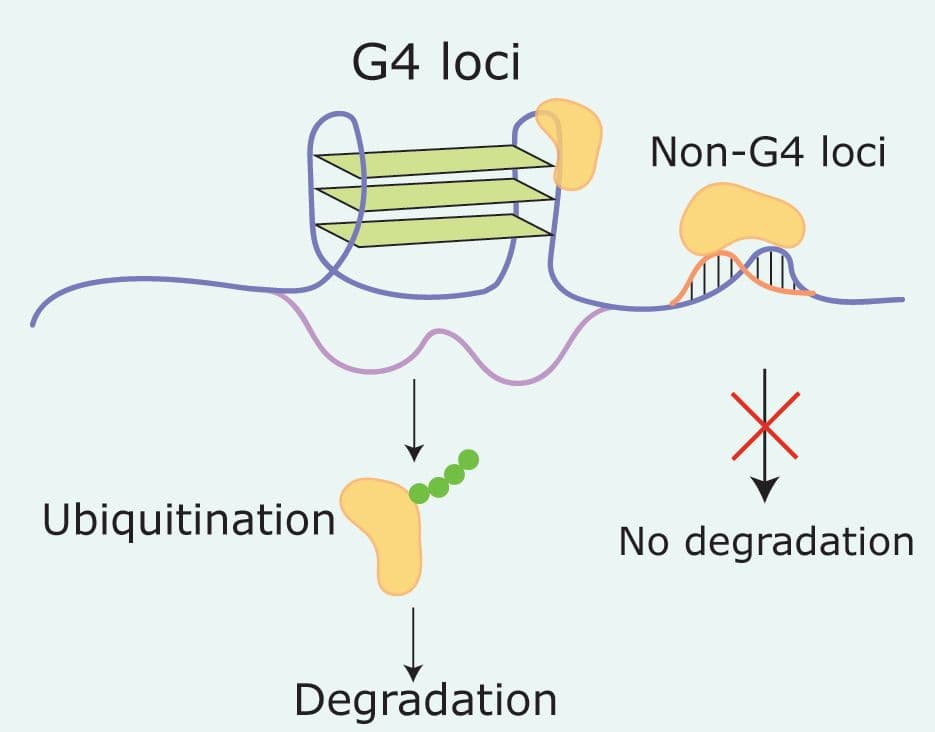
Noncanonical G-quadruplexes (G4) are unique DNA secondary structures that form in open chromatin at active transcription sites in certain G-rich regions; furthermore, they are particularly abundant in cancer states and are also associated with oncogenes. Recent work by Wang et al. identified a novel PROTAC that specifically recognized G4 structures and promoted the degradation of proximal transcription factors and other chromatin regulatory proteins in their native chromatin environment. Initial work involved developing a PROTAC that specifically bound G4, had an optimal linker region to permit E3 ligase activity with adjacent proteins, and was cell permeable. Utilizing their G4L-PROTAC3 molecule, they effectively promoted the degradation of G4-binding proteins like SMARCA4 and FUS across multiple cell types. To confirm that the diminished levels of SMARCA4 were due to degradation, they treated cells with proteasome inhibitors, which was sufficient to prevent the reduction in SMARCA4 signal. They showed that, mechanistically, G4L-PROTAC3 promoted the endogenous SMARCA4 and PARP ubiquitination, which is a key mechanism in proteasome-mediated degradation of target proteins. Utilizing mass spectroscopy studies, the group determined that these G4L-PROTACs target both DNA- and RNA-associated G4 protein networks. The overall disruption in G4-associated proteins led to dysfunctional cell cycle progression and decreased cell viability. Cytoskeleton Inc.’s Signal-Seeker Ubiquitin Detection Kit (Cat. # BK161) played an integral role in assessing the endogenous ubiquitination state of target G4-associated proteins. This is quite important, as the group also identified several novel G4-binding proteins utilizing their PROTAC tool, and future studies may illuminate the precise roles of these novel G4-associated proteins and their importance in health and disease.