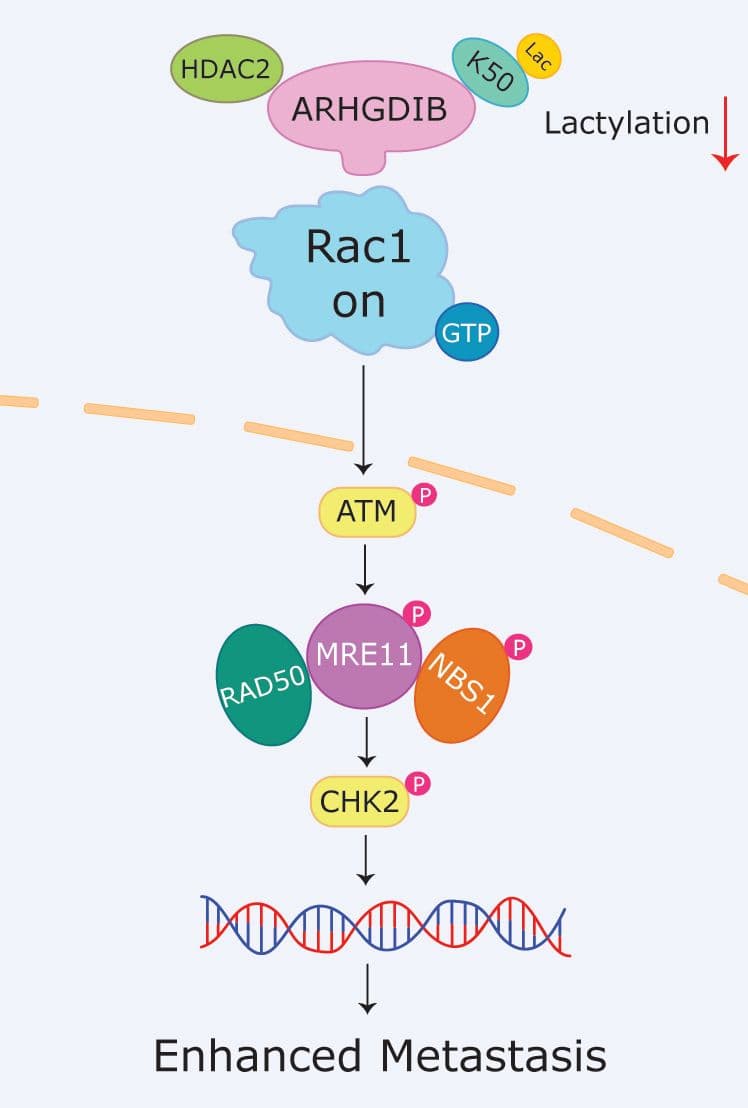
Well-established post-translational modifications (PTMs) such as phosphorylation, ubiquitination, and acetylation have been implicated in the progression of many cancers, including bladder cancer. Similarly, emerging evidence suggests that the non-canonicalPTM, lactylation, may play a role in linking metabolism to tumor progression; however, its precise role in bladder cancer has not been fully elucidated. Xu et al. identify a critical role for lactylation in regulating a key tumor suppressor, Rho guanosine diphosphate dissociation inhibitor β (ARHGDIB), to alter metastasis and chemoresistance in bladder cancer. Preliminary global profiling was performed to identify lactylation patterns, which resulted in the identification of 6,475 lactylation sites from 2,238 lactylated proteins. Of the top 10 differentially lactylated proteins, ARHGDIB emerged as a key candidate, and through a series of mass spectrometry and inhibitor/mutagenesis validation studies, amino acids K47 and K50 were identified as lactylation sites on this protein. Additional cellular and biochemical studies were performed to identify P300 and HDAC2 as the lactyltransferase and delactylase regulating ARHGDIB, respectively. Mechanistically, Delactylation of ARHGDIB weakened its binding to Rac1, thereby enhancing Rac1 activation. Collectively, this resulted in an enhanced DNA damage response, metastasis, and chemoresistance. Cytoskeleton Inc.’s Rac1 Pull-down Activation Assay (Cat. # BK035) was an important tool used for characterizing Rac1 activity in the presence of delactylated ARHGDIB. It will be interesting to determine how pervasive lactylation is as a mechanism to regulate small GTPase signaling in tumor progression and metastasis.
Link to Citation:
Product Used in Citation:
Rac1 Pull-down Activation Assay Biochem Kit (bead pull-down format) (Cat. # BK035)