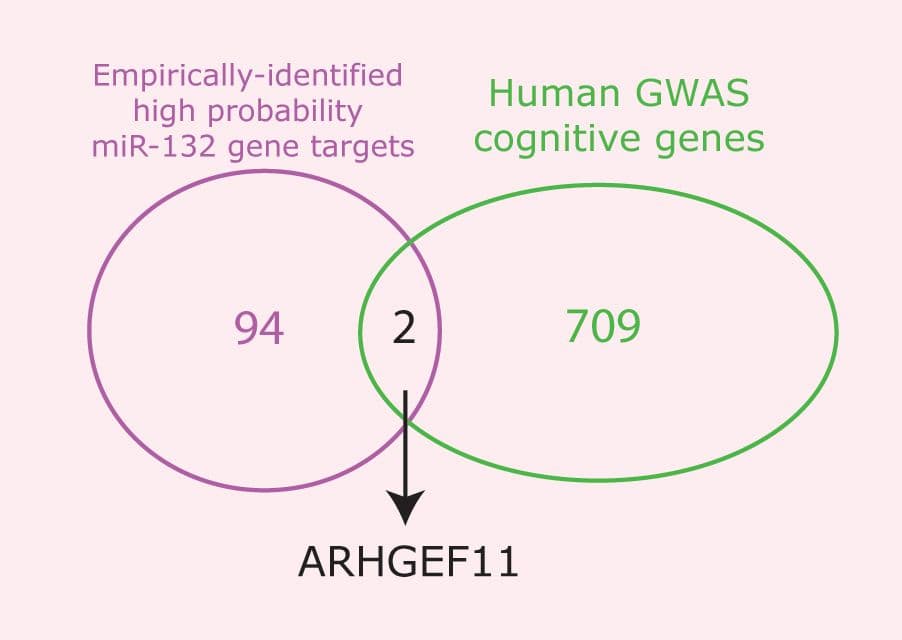
Understanding the cellular mechanisms and critical proteins involved in learning and memory has important implications in neurological health and disease. A large GWAS meta-analysis identified the RhoA gene as one of three hub genes essential for human cognition, but the precise regulatory mechanisms that control RhoA in neurons are still under intense investigation. Recently, Bjornson et al. used combinatory in silico studies to identify ARHGEF11 as a key gene affecting cognition. Initial studies focused on miR-132 because its expression is strongly linked to cognitive abilities and is dysregulated during cognitive impairment. They compared a set of miR132 target genes (92 genes) with a GWAS set of genes linked to general cognitive function (709 genes), which led to the identification of ARHGEF11 as a potential target. Molecular studies showed that ARHGEF11 is a direct target of miR132, and specific depletion of miR132 in the medial prefrontal cortex in mice led to increased levels of PDZ-RhoGEF (the protein expressed by ARHGEF11). Importantly, increased PDZ-RhoGEF levels, either through miR-132 depletion or direct overexpression, led to cognitive impairment in mice. At the cellular level, PDZ-RhoGEF overexpression caused reduced thin spine density, while also enhancing stubby spine-head diameter. Additional biochemical studies identified the scaffolding-like protein DISC1 as a direct binding partner and showed that this interaction is critically important for PDZ-RhoGEF’s ability to activate RhoA. Cytoskeleton Inc.’s RhoA Pull-down Activation Assay Biochem Kit (Cat. # BK036) was a critical tool used to analyze RhoA levels in their overexpression and in vivo studies. This study identified critical mechanisms involving miRNAs, scaffolding proteins, and GEFs that act on RhoA signaling to influence cognition.
Link to Citation:
Product Used in Citation:
RhoA Pull-down Activation Assay Biochem Kit (bead pull-down format) (Cat # BK036)