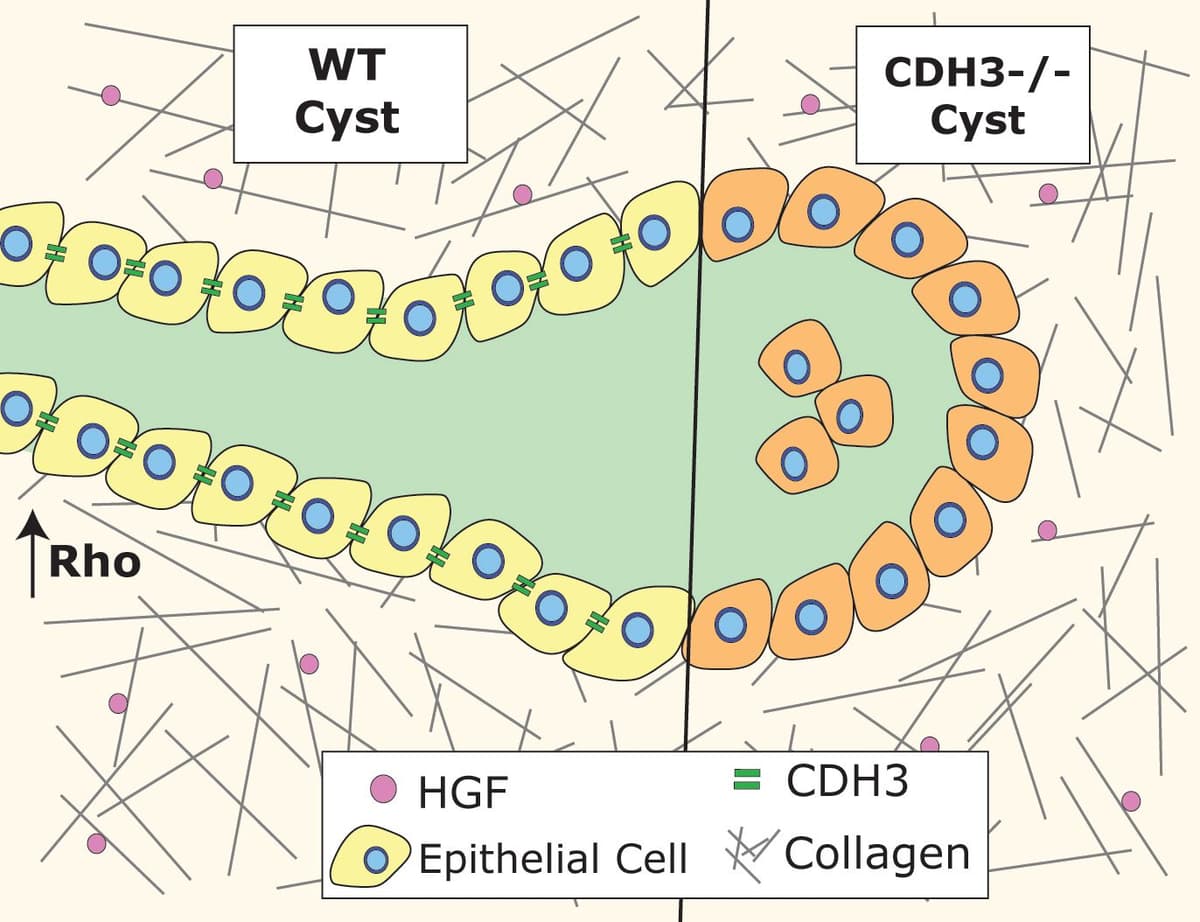
Understanding how epithelial cells form cysts is important, as dysregulation of cyst morphology is observed in diseases like cancer and developmental disorders. Cell protrusion, lumen formation, and tubule formation are all important components of cyst formation, but it is unknown whether all cadherin proteins, which are important in regulating migration, also contribute to these epithelial morphological changes. Tran et al. recently investigated whether P-cadherin (CDH3) can regulate these cell morphological changes in an epithelial cell model stimulated with HGF to induce tubulogenesis. The group performed preliminary studies to develop a Madin-Darby canine kidney (MDCK) 3D cultured morphogenesis model using wild-type and CDH3 CRISPR-Cas9 knockout cells in order to study its effects on lumen formation and cell protrusions. Before performing the morphogenesis studies, they examined how the knockout of CDH3 impacted cell migration, and as expected, migration was significantly impaired in cells lacking CDH3. They then performed 2D HexForce traction force assays, which measure dot deflection by MDCK cells on patterned fibronectin/collagen dots. MDCK cells with CDH3 knockout generated 50% less force on their surroundings compared to wild-type cells, which correlated with the reduced migration observed. Next, they examined CDH3’s effect on lumen formation in their 3D morphogenesis model and observed dysregulated lumen development in cells depleted of CDH3. Similarly, they also showed that CDH3 was important in stable HGF-induced cell protrusions in their morphogenesis model. Mechanistically, they found that CDH3 utilizes RhoA signaling pathways to control these morphological changes, and utilizing a RhoA-stimulating agent in CDH3 knockout cells was sufficient to restore cell protrusions in response to HGF treatment similar to wild-type cells. Collectively, this study identified the importance of P-cadherin in the regulation of epithelial cyst cell protrusion and lumen formation. Cytoskeleton Inc.’s Rhodamine Fibronectin (Cat. # FNR01) and RhoA Activator II (Cat. # CN03) were critical tools that were used to define P-cadherin’s role in regulating epithelial cell morphogenesis.
Link to Citation:
Product Used in Citation: