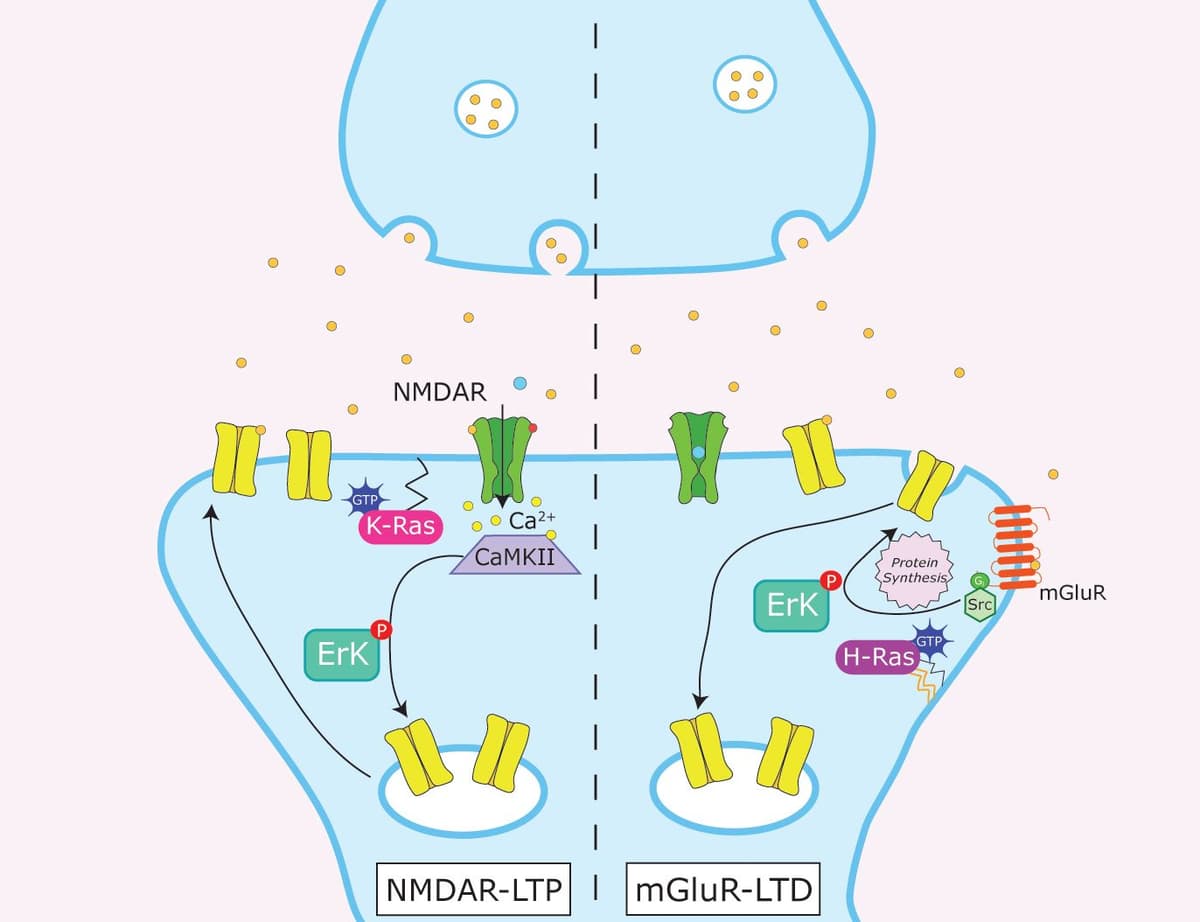
With the recent breakthrough in Ras-targeted therapies in cancer, there has been a laser focus on Ras’ role in tumor progression and malignancy. Still, Ras is known to play a significant role in several other diseases; for instance, RASopathies collectively have been identified as one of the leading causes of cognitive and neurodevelopmental disorders. How Ras signaling affects synaptic plasticity is still unclear, but recent work by López-Merino et al. sought to uncover the role that Ras isoforms play in neuronal function and cognition. The group utilized genetically modified mice expressing a dominant-negative H-Ras in combination with several types of assays to analyze Ras in the brain. Utilizing electrophysiological studies, they showed that disrupting post-synaptic HRas signaling had profound effects on mGluR long-term depression (LTD) effects. To validate that mGlur-LTD induction stimulated Ras activation, the group performed Ras activation assays from drug-stimulated hippocampal slice extracts. Interestingly, both DHPG (LTD activation) and chemical long-term potentiation (LTP) stimulation activated Ras signaling, which suggested that opposing actions both stimulate Ras activation. Additional studies determined that HRas-dependent effects on dendritic spine formation during mGluR-LTD were activated by c-Src and were mediated through ERK signaling. Behavioral studies showed that disruption of HRas signaling led to impaired social and spatial memory, as well as diminished object recognition. In contrast, the group showed that K-Ras, but not H-Ras, played an essential role in NMDAR-LTP. The group attributed these differences to Ras isoform-distinct subcellular localization, which they determined via fractionation studies from hippocampal extracts. These findings may help explain how opposing effects on the synapse can utilize overlapping downstream Ras signaling pathways and shine a light on studying these Ras isoforms in neuronal function. Cytoskeleton Inc.’s Ras Pull-down Activation Assay (Cat. # BK008) was a critical assay for understanding how Ras activation occurred in hippocampal brain slices in response to various stimulants.
Link to Citation:
Product Used in Citation:
Ras Pull-down Activation Assay Biochem Kit (bead pull-down format) (Cat # BK008)