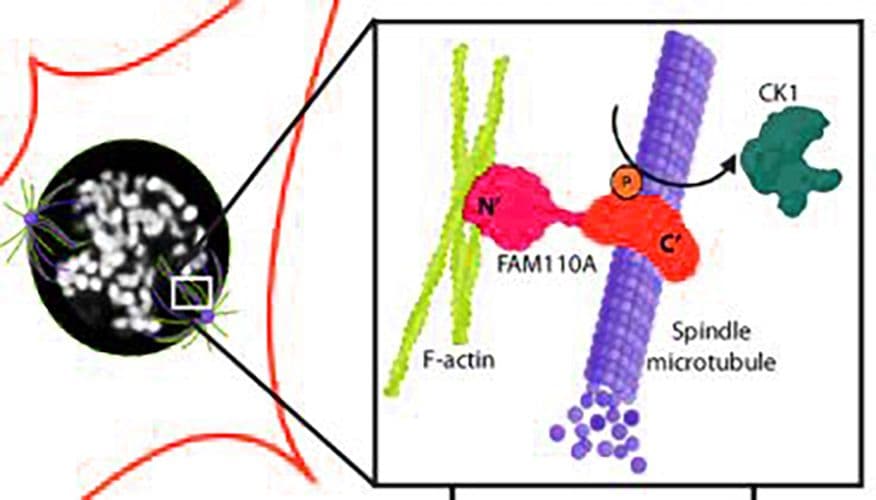
Actin filament formation near microtubule-organizing centers during mitosis has been observed, but its precise function remains poorly defined. Furthermore, identifying actin-binding proteins that control actin function near the mitotic spindles is still relatively unknown. Recently, the Macurek Lab identified the FAM110A protein as a critical regulator of mitotic spindle formation through its ability to scaffold microtubules and actin. The group previously showed that FAM110A interacted with both of these cytoskeletal proteins; in this study, they utilized deletion mutants to show that the N-terminal domain of FAM110A binds actin, while the C-terminal domain is required for tubulin binding. Next, they attempted to rescue mitotic delay caused by the depletion of endogenous FAM110A by expressing an EGFP-FAM110A mutant deficient in either actin binding or tubulin binding. Interestingly, both of these mutants were insufficient at rescuing impaired mitosis, suggesting that FAM110A interaction with actin and/or tubulin is critical for mitosis. Additional experiments showed that this FAM110A-actin interaction was important for proper chromosomal alignment. Using confocal microscopy assays the group showed that FAM110A co-localized with spindle actin and microtubules. They then performed in vitro binding assays to show that FAM110A promoted crosslinking of F-actin to microtubules, and this interaction was severely reduced with FAM110A mutants deficient in actin or microtubule binding. Utilizing live cell assays, the group further defined the importance of FAM110A and its regulatory protein, Casein Kinase 1, in controlling the formation of actin spindles and regulating the interaction with microtubules. This study reveals a critical role for actin at the mitotic spindle and identifies FAM110A as a key regulator of actin in this process. Cytoskeleton Inc.’s fluorescent (Cat. # TL670M) and biotinylated (Cat. # T333P) tubluins, as well as its purified actin protein (Cat. # AKL99) were critical tools to investigate the interaction between FAM110A, tubulin, and actin in this study.
Link to Citation:
Products Used in Citation:
Tubulin protein (fluorescent HiLyte 647): porcine brain (Cat # TL670M)
Tubulin protein (biotin): porcine brain (Cat # T333P)
Actin protein (>99% pure): rabbit skeletal muscle (Cat # AKL99)