
Protein Assays
Developed by Scientists at Cytoskeleton, the Advanced Protein Assay (Cat. # ADV01) and the Precision Red Advanced Protein Assay (cat. # ADV02) are highly recommended for measuring purified protein and total cell protein alike. The advantages of ADV01 are the low detection limit (0.25 µg protein/ml sample) and the highly similar readings between the same amounts of different purified proteins. ADV02 is less sensitive but more compatible with detergents, and retains the same similarity between different purified proteins. In comparison to the Bradford assay these assays read different purified proteins with two fold greater accuracy which allows the user to rely on the simple A = Ecl formula to convert the OD into a real protein concentration.
For protein assay protoocols, click here.
For more information see the datasheets, or contact Technical Support at tservice@cytoskeleton.com .
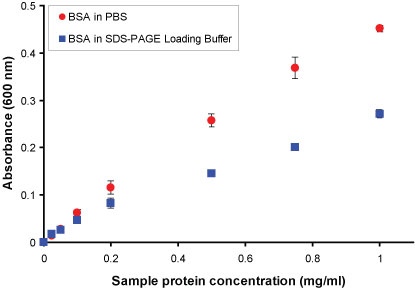
Many publications cite the use of Cytoskeleton's kits in the Materials and Methods section of papers. Usually the citation is associated with a particular result in the form of a graph or image that helps the you, the authors, present your findings. This indicates the utility of the Kits to produce publication quality data in a short timeframe thus helping improve the productivity of your efforts. Example citations for protein assay kits are shown below. More citations are available on individual product pages.
Advanced Protein Assay: 5x stock (Cat. # ADV01) | ||||||||
Kuroda K. et al. 2015. Role of p53 in the progression from ochratoxin A-induced DNA damage to gene mutations in the kidneys of mice. Toxicol. Sci. 144, 65-76.
Used to quantify protein lysates prior to western blotting.
|
Question 1: Which is the best protein assay for measuring total cell protein in a cell extract?
Answer 1: We recommend the Precision Red Advanced Protein Assay Kit (Cat. # ADV02). This protein assay kit is designed to extend the linear range of protein measurement, a limiting factor in other protein assays. The reagent combines the useful properties of low protein to protein variance and a broad linear response to many types of purified proteins. A simple one step procedure results in a red to purple/blue color change characterized by an increase in absorbance at 580 to 620 nm. A compatibility chart is included in the kit's manual.
Question 2: What equipment do I need for measuring the color change?
Answer 2: The equipment needed to use the either the Advanced Protein Assay (Cat. # ADV01) or the Precision Red Advanced Protein Assay Kit (Cat. # ADV02) is a spectrophotometer capable of measuring 580 to 620 nm wavelength (optimally 600 nm), small volume cuvettes (1.0 ml) or 96-well plates, pipettors (3-20 μl, 100-1000 μl and 10 ml capacity) and 1.5 or 15 ml disposable tubes.
For more information, click on the Document tab above and see the datasheet, or contact Technical support at tservice@cytoskeleton.com.
- Precision Red Advanced Protein Assay: 1x stock ADV02Learn MorePrecision Red Advanced Protein Assay: 1x stock